Bound access and actions
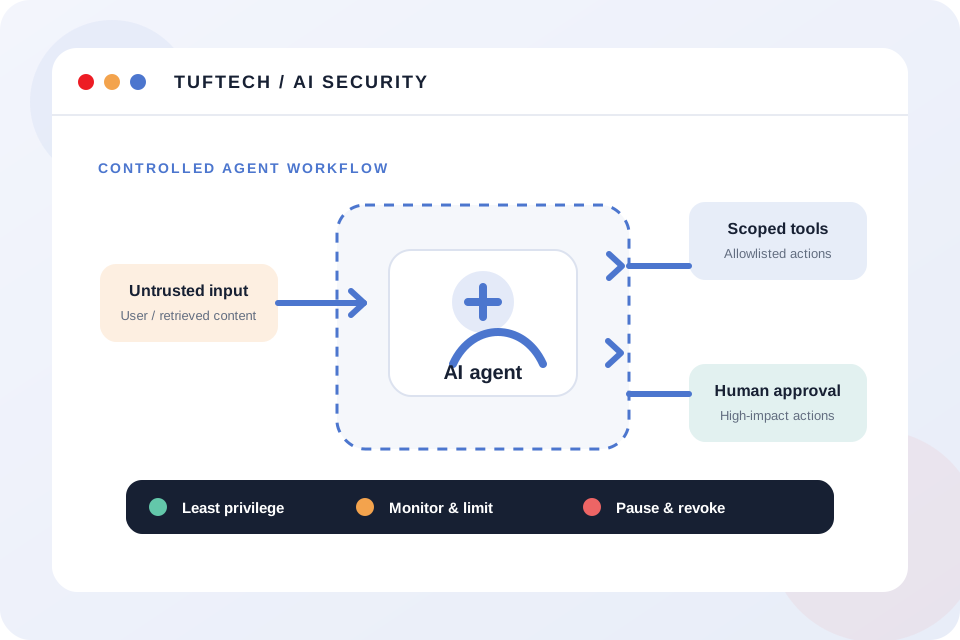
Use dedicated identities, least-privilege permissions, scoped credentials, tool allowlists and human approval for consequential actions.

Identify and reduce security risks where AI agents can access data, call tools or take actions across your systems.
Discuss an AI security assessmentSecurity for systems that can act
AI agents combine a model with instructions, data sources, memory and tools. A compromised or misdirected agent may expose information or make unintended changes using the permissions it has been given. We help teams map those paths, agree a proportionate assessment scope and prioritise safeguards for their actual deployment.
The review can cover custom agents and systems assembled from external models, orchestration frameworks, plugins, APIs and Model Context Protocol (MCP) servers. Testing is limited to systems and techniques authorised in writing.
AI-specific threat modelling
Prompt injection is not solved by a system prompt alone. We examine how an agent handles untrusted instructions and tool results, what data and actions its identity can reach, and whether important operations require meaningful human authorisation. Controls are considered across the model, application, tools, data stores and operating environment.
Where personal information is involved, the review can identify data-protection questions for the controller to assess, including purpose, minimisation, access, retention, transparency and whether a data protection impact assessment is needed. Legal decisions and DPIA approval remain with the organisation and its advisers.
Scope an assessmentUse dedicated identities, least-privilege permissions, scoped credentials, tool allowlists and human approval for consequential actions.
Constrain what enters prompts and memory, isolate tenants and execution, validate tool inputs and outputs, and control network egress.
Define monitoring, safe failure, rate limits, incident response, revocation and a tested means to pause or disable an agent.
A scoped and evidence-led review
We agree objectives, assets, access, test conditions and operational safeguards before assessment. The work is proportionate to the deployment and does not imply that every possible weakness can be found.
Document use cases, models, identities, tools, data flows, trust boundaries, dependencies and impact if an action goes wrong.
Review design and configuration, and perform only the tests authorised in the written scope and safe test environment.
Share evidence-based findings, explain limitations, prioritise safeguards and agree any follow-up or retest scope.
Tell us what the agent can access and do. We can discuss an appropriately scoped security review.